
Xycoon logo
Hypothesis Testing
Home    Site Map    Site Search    Xycoon College    Free Online Software    
horizontal divider
vertical whitespace

Hypothesis Testing - Statistical Test of Variance - Theory & Examples

[Home] [Introduction] [Mean (var. known)] [Variance] [Mean (var. unknown)] [Pop. Proportion]

Theory: [Population] [Sample] [Overview] [Chi-square distribution] [Chi-square Approximation] [Sample Variance Distribution] [Summary]
Examples: [Critical Value] [P-Value] [Confidence Intervals for Sample Variance] [Confidence Intervals for Population Variance]


Statistical Hypothesis: Testing Variance -- Population

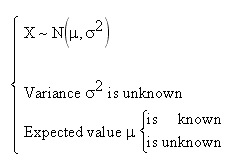
Population distribution:

Population distribution: X is normally distributed, variance is unknown, expected value is known or unknown

[top]


Statistical Hypothesis: Testing Variance -- Sample

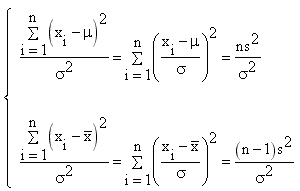
Sample statistics:

sample statistic: n times the sample variance over the population variance

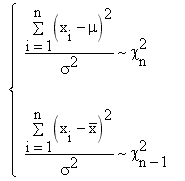
Sample distribution:

the sample statistic has a chi-square distribution with n degrees of freedom (mean is known) or n-1 degrees of freedom (mean is unknown)

[top]


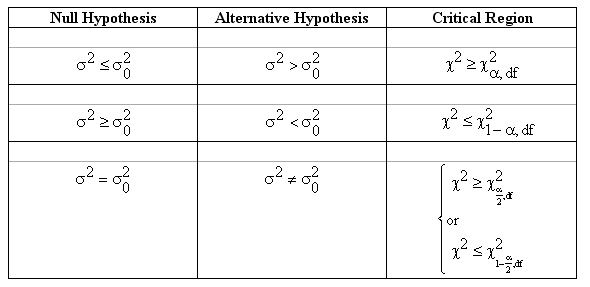
Statistical Hypothesis: Testing Variance -- Critical Region

Table overview:

[top]


Statistical Hypothesis: Testing Variance -- the Chi-square distribution

Definition

Let X be a stochastic variable following a normal distribution with expected value mu and variance equal to sigma-squared

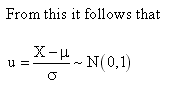
From this it follows that u = (X - mu) over sigma is standard normally distributed

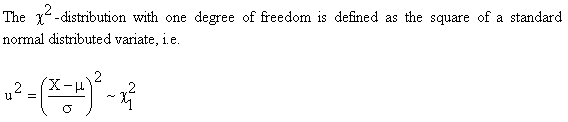
The Chi-square distribution with one degree of freedom is defined as the square of a standard normal distributed variate

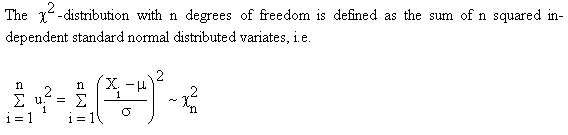
The Chi-square distribution with n degrees of freedom is defined as the sum of n squared in-dependent standard normal distributed variates

[top]


Property 1

The sum (difference) of two independent  Chi-square distributed variates, with degrees of freedom n1 and n2 respectively, is also Chi-square distributed with degrees of freedom equal to the sum (difference) of the degrees of freedom (n1, n2).

Property 2

The expected value of a Chi-square distributed variate is equal to the number of degrees of freedom

The variance of a Chi-square distributed variate is equal to two times the number of degrees of freedom

[top]


Statistical Hypothesis: Testing Variance -- Approximation of the Chi-square distribution

Rule of thumb

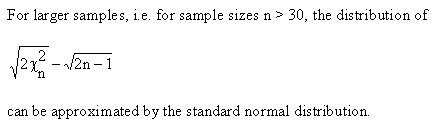
For larger samples, i.e. for sample sizes n > 30, the distribution can be approximated by the standard normal distribution.

Example

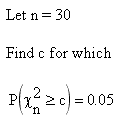
Find the critical value for the chi-square distribution if n = 30 and alpha (type I error) = 5%

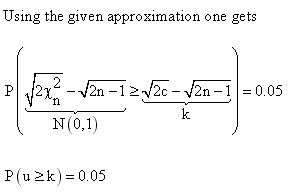
using the normal approximation

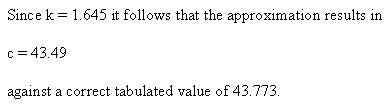
since k = 1.645 it follows that the approximation results in c = 43.49 against a correct tabulated value of 43.773.

[top]


Statistical Hypothesis: Testing Variance -- Distribution of Sample Variance

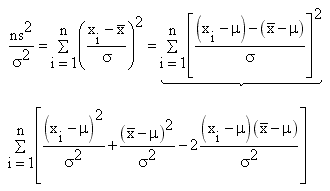
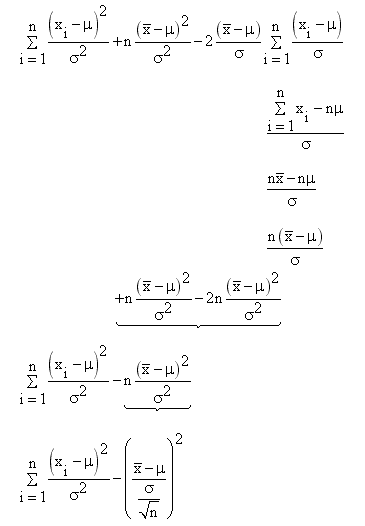
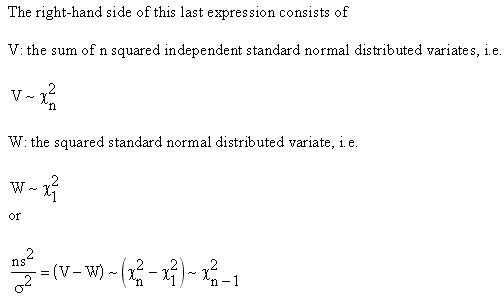
Proof

formula

formula

solution

[top]


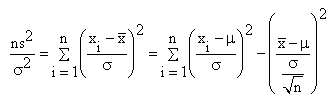
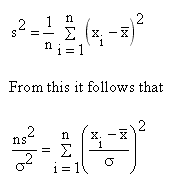
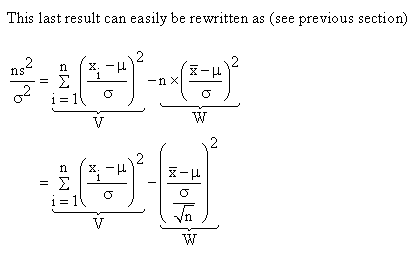
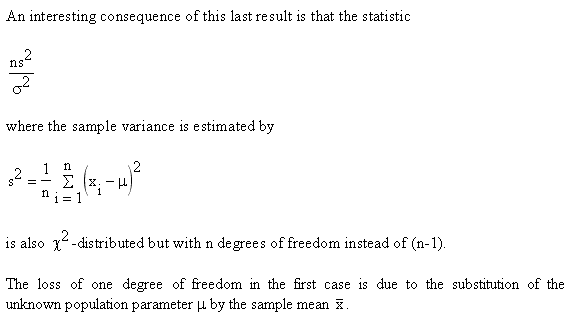
From a random sample, with sample size n and drawn from a population following a normal distribution and given mean and standard deviation, the sample variance can be estimated as described in the following cases.

Estimation - Case 1: mean is unknown

formula

formula

formula

[top]


Estimation - Case 1: mean is known

formula

[top]


Statistical Hypothesis: Testing Variance -- Summary

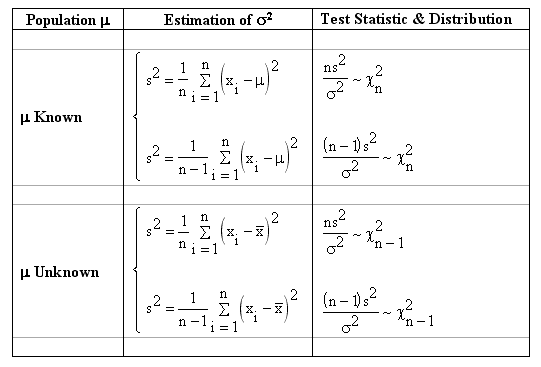
Estimation of variance - distribution of test statistic - degrees of freedom

summary

[top]


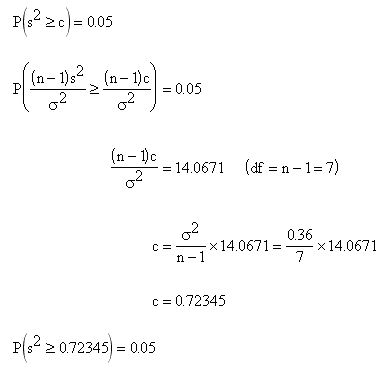
Statistical Hypothesis: Testing Variance -- Example 1: Critical Value (Region)

Free Statistics Software (Calculator)

use this Software (Calculator) to solve this problem

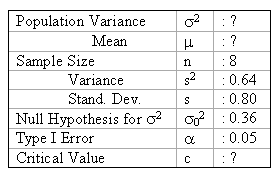
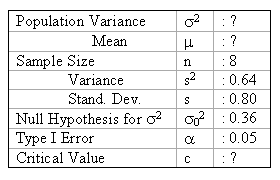
Problem

problem

Solution

solution

Conclusion

conclusion

[top]


Statistical Hypothesis: Testing Variance -- Example 2: P-value (probability)

Free Statistics Software (Calculator)

use this Software (Calculator) to solve this problem

Problem

problem

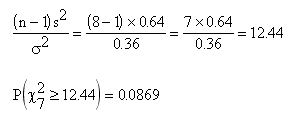
Solution

solution

Conclusion

conclusion

[top]


Statistical Hypothesis: Testing Variance -- Example 3: Confidence intervals for Sample Variance

Free Statistics Software (Calculator)

use this Software (Calculator) to solve this problem

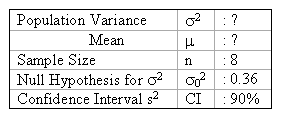
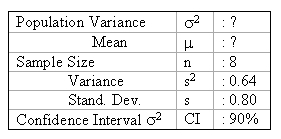
Problem

problem

Solution

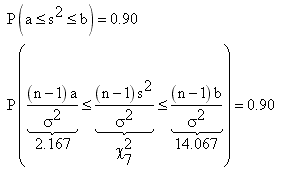
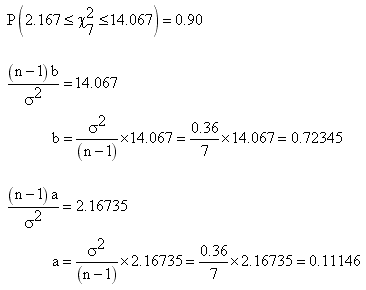
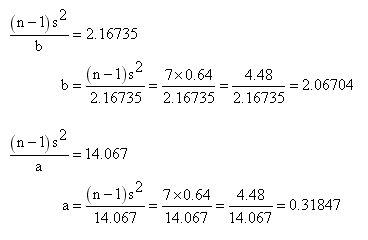
solution (part 1)

solution (part 2)

solution (part 3)

Conclusion

conclusion

[top]


Statistical Hypothesis: Testing Variance -- Example 4: Confidence intervals for Population Variance

Free Statistics Software (Calculator)

use this Software (Calculator) to solve this problem

Problem

problem

Solution

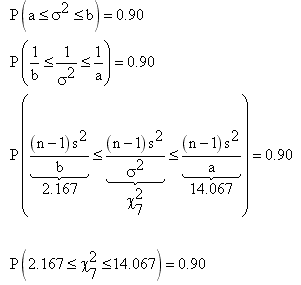
solution (part 1)

solution (part 2)

solution (part 3)

Conclusion

conclusion

[top]


vertical whitespace


Home
Introduction
Mean (var. known)
Variance
Mean (var. unknown)
Pop. Proportion
horizontal divider
NEWS FEED from BBC News : Statistical Research
Heavy drinkers 'lie to doctors'Almost two in five people who drink to excess lie to their doctor about how much alcohol they really consume, says a survey.
UK net immigration up to 237,000Net immigration to the UK increased by 46,000 in 2007 to 237,000, according to official statistics.
UK migration: What the figures meanWhat do the 2007 figures tell us about migration and population in the UK?
Tech that trumps traffic tanglesThe location data of satellite navigation systems looks set to improve traffic monitoring and town planning.
EU thumbs-up for 'Polish plumber'Eastern and Central European workers have not distorted labour markets in older EU member states, a new EU report says.
Are we negative about our children?The divide between older and younger generations has sparked a debate about the behaviour of young people in society.
Surviving the property turmoilAs Britain's housing market crisis continues, the downturn is taking its toll on the once-booming rental market on both landlord and tenants alike.
Practice News Day around the UKSchools across the UK are taking part in a practice News Day on 13 November 2008 in preparation for the UK-wide event in March.
'Love handles' risk early deathCarrying extra fat around your middle increases your risk of early death, even if your overall weight is normal, say researchers.
Further jobless increase expectedA rise in UK unemployment expected in official figures later could take the jobless total to its highest level for a decade.
Family suicides on rise in TaiwanAs Taiwan's financial gloom deepens, experts fear the trend for parents taking their lives and that of their children will rise further.
Premature births 'are increasing'There has been a dramatic rise in the number of babies being born prematurely in England, a charity has warned.
Drug 'tricks body to lose weight'Scientists say they have found a drug that can trick the body into burning off fat even when continuing on a high-fat diet.
As it happened: The US votesKeep up with the drama of US election day on 4 November on the BBC News website.
Forces mental illness figures outFigures show nearly 4,000 new cases of mental health disorder were diagnosed among armed forces personnel last year.
Q&A: Alcohol and pregnancyA new study is published, showing children born to women who drink a small amount of alcohol during pregnancy are not at increased risk of behavioural problems.
Tsunami in 2004 'not the first'Research on sediments on Indian Ocean shores reveals centuries-old evidence of large tsunami in the region.
Civil service absence off targetSickness absence levels in Northern Ireland's civil service are still not meeting government targets, statistics show.
Parties chase Asia-Pacific voteVoters in the Asian American and Pacific Islander communities could could play pivotal roles in key election states, Rajesh Mirchandani reports.
The UK is on recession watchBBC economics editor Hugh Pym explains why we are probably in a recession, even though official data has yet to show it.
horizontal divider

© 2000-2008 - Office for Research, Development, and Education (called ORDE) - All rights reserved. This website is published by ORDE and owned by Resa R&D. This includes: html content, graphical illustrations (gif, jpg, and png files), computer software, online or electronic documentation, associated media, and printed materials. All Photographs (jpg files) are the property of Corel Corporation, Microsoft and their licensors. ORDE has acquired a non-transferable license to use these pictures in this website.
The free use of the scientific content in this website is granted for non commercial use only. In any case, the source (url) should always be clearly displayed. Under no circumstances are you allowed to reproduce, copy or redistribute the design, layout, or any content of this website (for commercial use) including any materials contained herein without the express written permission of ORDE.

Information provided on this web site is provided "AS IS" without warranty of any kind, either express or implied, including, without limitation, warranties of merchantability, fitness for a particular purpose, and noninfringement. ORDE uses reasonable efforts to include accurate and timely information and periodically updates the information without notice. However, ORDE makes no warranties or representations as to the accuracy or completeness of such information, and it assumes no liability or responsibility for errors or omissions in the content of this web site. Your use of this web site is AT YOUR OWN RISK. Under no circumstances and under no legal theory shall ORDE be liable to you or any other person for any direct, indirect, special, incidental, exemplary, or consequential damages arising from your access to, or use of, this web site.

Contributions and Scientific Research: Prof. Dr. E. Borghers, Prof. Dr. P. Wessa
Please, cite this website when used in publications: Xycoon (or Authors), Statistics - Econometrics - Forecasting (Title), Office for Research Development and Education (Publisher), http://www.xycoon.com/ (URL), (access or printout date).
Facilities, development, and design: Office for Research, Development, and Education

Comments, Feedback, Bugs, Errors | Privacy Policy Web Awards