Xycoon logo
Bayes Theorem
Home    Site Map    Site Search    Xycoon College    Free Online Software    
horizontal divider
vertical whitespace

Introduction to Econometrics - Bayes Theorem

[Home] [Up] [Probability] [Axiom System] [Random Variables] [Matrix Algebra] [Distribution Theory] [Estimator Properties] [Bayes Theorem]


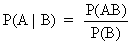
As defined earlier

Introduction to Econometrics - Bayes Theorem

(I.II.1)

and of course

(I.II.2)

Since P(A B) = P(B A) it follows by substituting (I.II.2) into (I.II.1) that
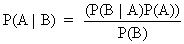
(I.II.3)

Equation (I.II.3) shows clearly that the chance of A given B can be expressed as a function of the chance of B given A!

The left hand side of (I.II.3) is called the posterior probability,

P(A) is called the prior probability, and P(B) is the probability of B whether A is true or not.

It is quite obvious that (I.II.3) can be rewritten as:

(I.II.4)

where A has been replaced by H (a hypothesis) and B by D (observed data).

In other words: the probability of the hypothesis being true, given the fact that specific data have been observed, varies with the likelihood of the observed data when the hypothesis is true times the prior probability (subjective probability) of the hypothesis.

As a matter of fact, equation (I.II.4) is a simplified version of Bayes' theorem. By extending (I.II.4) just a little bit, a very useful equation can be found. In fact one only has to think of two different hypotheses Hyp1 and Hyp2 and apply equation (I.II.4) to them.

It is easily found that
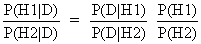
(I.II.5)

or in words: the posterior odds equal the likelihood ratio multiplied by the prior odds (Bayes' theorem).

The only question remaining is: how can this theorem be applied usefully in practice? A very simple example should clarify the usefulness of this theorem.

Suppose that there are two sacks of gold and silver coins. Both have been shuffled thoroughly. Denote the first sack as Hyp1 and the second as Hyp2. Furthermore, it is known that in the first sack there are 150 gold coins and only 50 silver coins, in the other sack there are 100 and 200 coins respectively.

Suppose that one had the opportunity to draw a coin out of one sack, and suppose that one would pick a gold coin. What is the chance of the drawn coin to come from the first sack?

Assuming that both sacks have the same chance of being picked, not regarded the outcome of the drawing, this problem can be solved quite easily by applying Bayes' theorem as follows:
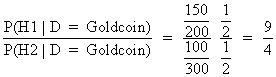
(I.II.6)

An important issue, when applying Bayes' theorem or Bayes' regression techniques is that there always is a subjective (prior) probability that is being incorporated in solving the problem. This can be of great importance (e.g., if the researcher has expert knowledge on some events and can therefore influence the outcome of the investigation with his "a priori" assumptions/knowledge). At the same time this prior probability could be regarded as an immense drawback when wrongly used or interpreted.

From now on the discussion of classical econometrics will be our primary target. The classical approach does not use a priori knowledge to the full extent as in the Bayes' method, even if there are important economic theories that are known to be true.

From now on the economic theory will only be used as a guideline for econometric specifications and checking of econometric models a posteriori.

vertical whitespace


Home
Up
Probability
Axiom System
Random Variables
Matrix Algebra
Distribution Theory
Estimator Properties
Bayes Theorem
horizontal divider
NEWS FEED from BBC News : Statistical Research
'Huge contrasts' in devolved NHSSeparate health policies across the UK are leading to wide differences for patients, it is claimed.
The school uniform price warWith children preparing to return to school, a price war has broken out over school uniforms. aimed at parents who are feeling the credit squeeze.
Britain's happiest places mappedThe most sparsely populated county in Wales is Britain's happiest place - but Edinburgh the least happy, say researchers.
Shetland obesity study dismissedHealth chiefs on Shetland dismiss research which claims the islands are the fattest area of the UK as "misleading and simplistic".
Study reveals teen self-harm rateA study suggests that up to 14% of 15 and 16-year-olds across central Scotland have self-harmed.
'Complexity' of Neanderthal toolsEarly stone tools developed by modern humans were no more advanced than ones used by the Neanderthals, research shows.
Councils urged to retain migrantsThe government should plan better so communities are boosted by the economic benefits generated by migrant workers, a think tank says.
In quotes: UK economic growth stallsUK economic growth ground to a halt between April and June, official figures show, heightening fears of a recession.
McCain cheers gloomy RepublicansThe BBC's Richard Lister examines looks at John McCain' strong performance in the opinion polls, despite the media's focus on his rival.
Drop in East European migrationThe number of Eastern European migrants coming to work in the UK has fallen to its lowest level since 2004, statistics show.
Public finances improve slightlyBritain's public finances get a boost from strong North Sea oil tax revenue, but are still weaker than a year ago.
Putting percentages in contextPercentages might make news stories stand out, but without a connection to the human experience, can become meaningless. In his third lesson of a weekly series, author Michael Blastland gives some hints for percentages.
Rise in people accessing HIV careThe number of people in the north west of England accessing HIV treatment is continuing to rise, new research says.
Traditional names are 'dying out'Traditional British names such as Norman and Gertrude Edna are in danger of dying out, a survey suggests.
Feeling the heat of food securityWhy reforming the economics of food production and supply would be beneficial for a number of environmental and social ills.
Bosses say education has worsenedSenior managers say education has declined over the last 10 years, despite record exam results.
Teens' test results to be issuedThe secondary school Sats test results for England are to be published although many are missing.
GB 'to meet' Olympic medal targetTeam GB should exceed a target of 41 medals at the Olympics demanded by sports minister Gerry Sutcliffe, research shows.
Call for better chemo counsellingDoctors are too worried to give patients with terminal cancer precise information about the benefits of extra chemotherapy, say researchers.
Upgrading road 'cut' fatalitiesResearch by surgeons claims the upgrading of a road cut the number of fatal accidents to zero within a year.
horizontal divider

© 2000-2006 - Office for Research, Development, and Education (called ORDE) - All rights reserved. This website is published by ORDE and owned by Resa R&D. This includes: html content, graphical illustrations (gif, jpg, and png files), computer software, online or electronic documentation, associated media, and printed materials. All Photographs (jpg files) are the property of Corel Corporation, Microsoft and their licensors. ORDE has acquired a non-transferable license to use these pictures in this website.
The free use of the scientific content in this website is granted for non commercial use only. In any case, the source (url) should always be clearly displayed. Under no circumstances are you allowed to reproduce, copy or redistribute the design, layout, or any content of this website (for commercial use) including any materials contained herein without the express written permission of ORDE.

Information provided on this web site is provided "AS IS" without warranty of any kind, either express or implied, including, without limitation, warranties of merchantability, fitness for a particular purpose, and noninfringement. ORDE uses reasonable efforts to include accurate and timely information and periodically updates the information without notice. However, ORDE makes no warranties or representations as to the accuracy or completeness of such information, and it assumes no liability or responsibility for errors or omissions in the content of this web site. Your use of this web site is AT YOUR OWN RISK. Under no circumstances and under no legal theory shall ORDE be liable to you or any other person for any direct, indirect, special, incidental, exemplary, or consequential damages arising from your access to, or use of, this web site.

Contributions and Scientific Research: Prof. Dr. E. Borghers, Prof. Dr. P. Wessa
Please, cite this website when used in publications: Xycoon (or Authors), Statistics - Econometrics - Forecasting (Title), Office for Research Development and Education (Publisher), http://www.xycoon.com/ (URL), (access or printout date).
Facilities, development, and design: Office for Research, Development, and Education

Comments, Feedback, Bugs, Errors | Privacy Policy Web Awards

This website is kindly sponsored by: Bandwidth Control | Time Series, Statistics Resources, and Statistics Software | Computer schools and technology degrees